
Creative Supervision
(or: the place where your coaching gets to exhale, stretch, and become something wiser)
Imagine you and I sitting down with a cup of tea (or coffee in my case), a messy bundle of yarn between us. Not the neat, shop-ready kind. The real kind. Knotted, looped, a bit stubborn. We don’t rush it. We gently tease apart the strands, follow where they lead, and slowly… something workable appears.
That is supervision.
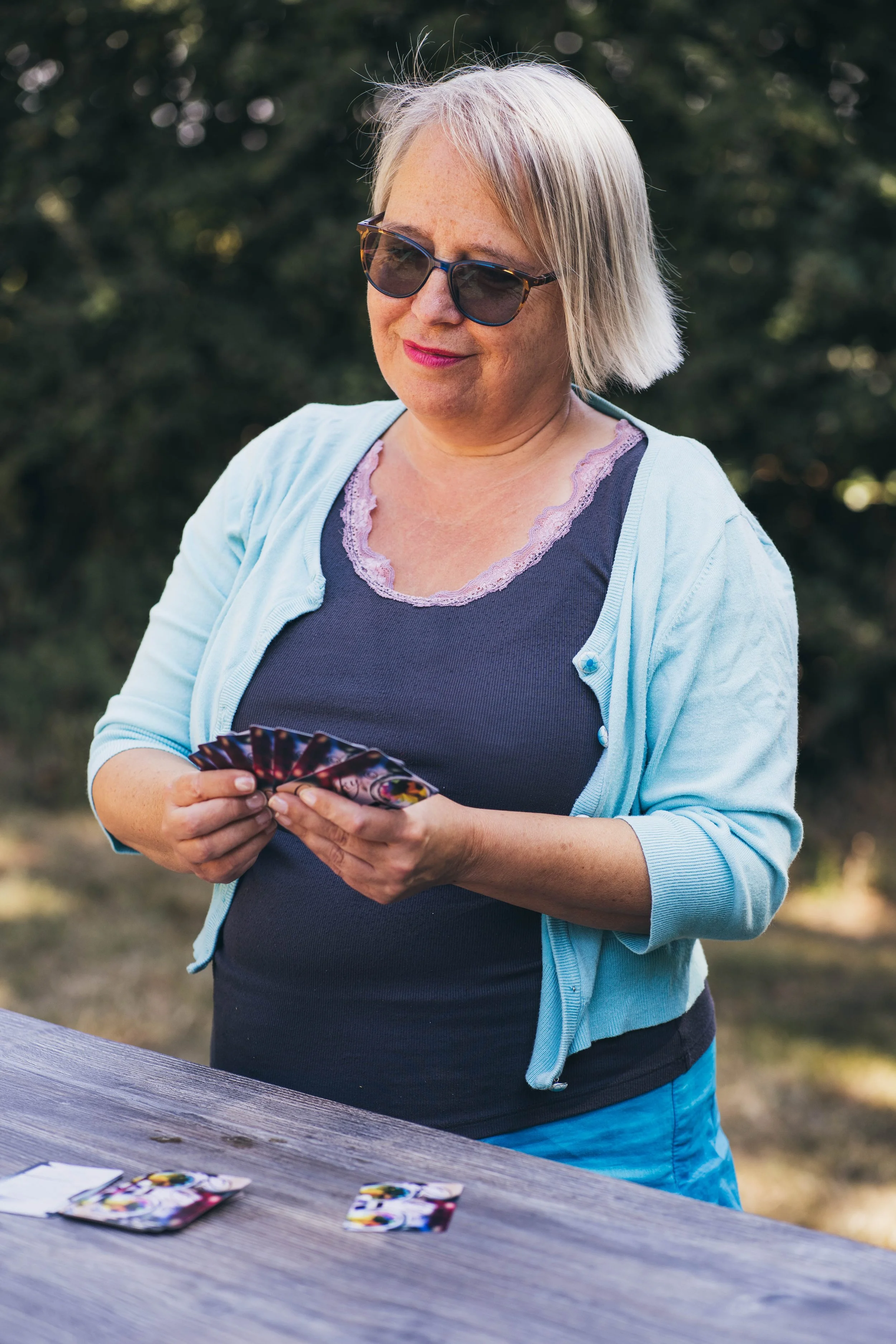
You might use paint, or pencils, tarot cards, poetry, whatever helps you to delve deeper into your client work, your professional development, and your own wellbeing.
A space where you get to reflect, become aware, and relax.

What is Coaching Supervision?
Normative - all about the ethics and daily practice with clients
Performative - identifying strengths and areas for development
Restorative - wellbeing of you, the coach. A place to process feelings.
Together, we explore:
Client work
We widen the lens. Zoom in, zoom out. Turn things sideways. What looked like a knot often becomes a pattern when we look together.
Your wellbeing
Because let’s be honest: coaching asks a lot of you. Holding space, regulating yourself, reading between the lines…
You cannot pour from an empty cup, and don’t want you to try.
Your development
Where are you heading? What seems to be calling you? What are you growing into, even if you can’t quite name it yet?
What makes this supervision different?
This isn’t supervision where you only talk.
We move. We imagine. We create.
I bring in:
metaphor work
drawing and visual exploration
parts work (inspired by Internal Family Systems)
embodiment and somatic awareness
occasional “this might feel a bit unusual, but trust me” experiments
And always, always, we stay grounded in real coaching practice.
There is also a clear neurodiversity lens here.
This space is for:
coaches working with neurodivergent clients
neurodivergent coaches
or anyone who senses that “one-size-fits-all” coaching doesn't quite fit
We explore how different brains show up in coaching relationships. Including yours.
Before We Begin
We start with a conversation. Not a formal interrogation. More like mapping the terrain together.
We’ll look at:
the kinds of clients you work with
what feels challenging or unclear
what you want more of in your practice
what growth looks like for you right now
This becomes our compass.
Ethics & Integrity
I work in alignment with the EMCC Global Code of Ethics.
In simple terms, that means:
I will be honest with you
I will be fair with you
I will hold your work with care and confidentiality
If something arises that could cause harm to you or your clients, we will face it together and decide on next steps.
I also have my own supervisor. Because no one should be doing this work alone, not even the supervisor.
How It Works (The Practical Bits)
Format: 1:1 supervision
Length: 1.5 hours (because depth takes time)
Frequency: Monthly (unless there are specific reasons why you would prefer a more ad hoc approach)
Approach: Structured enough to hold you, flexible enough to meet you
At some point, group supervision may emerge… when the timing feels right.
Roles & Responsibilities
My role is to:
Listen to what the words you say and the space between those words
Help you see both the detail and the bigger system
Guide reflective, creative exploration
Support your growth and your confidence
Challenge (with empathy) when needed
Care about your wellbeing as much as your competence
Your role is to:
Show up, fully and honestly
Be willing to reflect (even when it’s uncomfortable)
Stay curious about yourself
Try things that might feel a little outside your comfort zone
Allow your perspectives to be stretched
The Rhythm of Our Work
Every sixth session, we pause and look back:
What has shifted?
What feels different in your coaching?
What feels easier?
What still feels tangled?
And then we decide, together, what comes next.
A final note
Supervision, when it works well, is a bit like having someone walk alongside you with a lantern.
Not shining it in your eyes. Not dragging you forward.
Just quietly illuminating the path so you can see where you’re placing your feet.
If that sounds like the kind of space you’ve been looking for…
you are very welcome here.