Life is Beautiful
On rare occasions those random posts that Facebook pushes at you can be useful. One particular one talked about a 1997 Italian film about a concentration camp. And yet it was called ‘Life is Beautiful.’ The story talks about a father who, even in a concentration camp, tries to shelter his son from the reality of the situation, by pretending it is all a game. I have not seen the film, but even the premise made me cry.
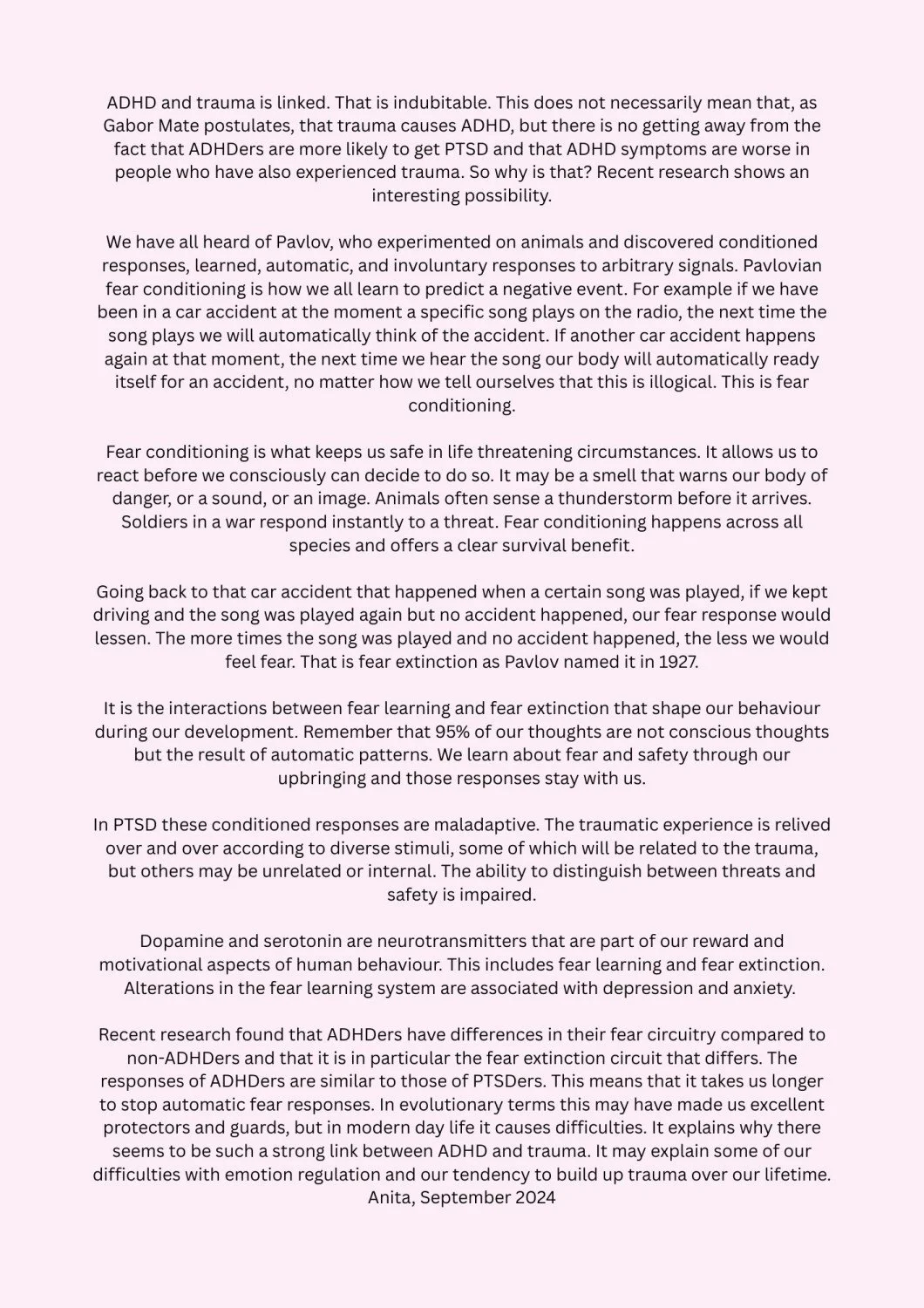
One of the themes that often pops up when I first talk to ADHD/nonADHD couples is that the ADHD partner struggles with anxiety, depression, or PTSD, and each time I explain that those co-occurring conditions are not to do with the ADHD itself, but are survival strategies put in place by a body that felt or feels threatened. Somewhere between 28 and 36% of ADHDers have PTSD, and research shows that PTSD affects ADHDers more strongly. On top of that, the association between ADHD and PTSD is even stronger in females than in males. It seems that ADHD is a risk factor for acquiring PTSD. So why is that?
ADHD children are more vulnerable to stress than nonADHD children. Not enough research has been done to be able to categorically say what the specific causes of that are, but it is thought that emotion dysregulation tendencies are part of those reasons. In addition to that, our fear circuitry is a little different.
The increased chance of PTSD in ADHDers means that preventative work is essential, and it is for that reason that the premise of ‘Life is Beautiful’ made me cry. Many years before I became an ADHD coach, I came across Martin Seligman and Positive Psychology. At the time it fascinated me because it gave me a language to use to explain what I so deeply felt was necessary in the world: a shift in the way people think about resilience. In my life I have had to uproot my life and start anew many times. I could not have done so, if I had allowed my fears and my anxious thoughts free reign. Instead I focused on building a new future.
One of the first major programmes Seligman designed was the US army resilience programme. Posttraumatic stress disorder affects about 1 in 5 US army veterans, who struggle with recurrent intrusive memories, emotional numbing, and a constant focus on trying to avoid these symptoms. All this to the cost of their daily lives, their work, their families, and their relationships. And yet other veterans experience post-traumatic growth, emerging stronger as a result.
When I worked as a SENCo (Special Educational Needs Coordinator) in a school, I so often heard the phrase ‘(s)he should become more resilient’ as if it was something a child had the choice to do. And yet no one gave them the tools. Outer and inner environments are inextricably linked. You cannot tell someone they ‘should be more resilient’ without shifting their environment as well as give them the tools to shift their internal environment. Both are essential. Resilience can be described as “a multidimensional construct that encompasses individual personality characteristics such as locus of control, disposition, self-esteem, assertiveness, and hardiness.”
Coming back to what makes ADHDers more likely to suffer from PTSD than experience post-traumatic growth, I wonder if our different time sense has something to do with it. In work with refugees, evidence emerged that the natural flow between past, present, and future is often disrupted. This can lead to an involuntary fixation on past traumas, and impacting the ability to engage with the present and even see the possibility of a future. ADHDers naturally have a different relationship with time. We value any immediate rewards much higher than a delayed reward. We have the tendency to live in the ‘now’ and discard the ‘not now’ (and according to Hallowell, the now is only 4 seconds long). Hyperfocus can make time disappear, and our inability to gauge time can set us into ‘waiting mode’ where we waste an entire day because our brain blocks us from doing anything in order to ensure we reach our appointment on time. It would seem logical that we also have a tendency to fixate on past traumas.
Intrusive thoughts, fixating on past experiences and the feelings they elicit, and desperately avoiding any triggers are typical symptoms of PTSD and they can lead to internal stress, isolation, and self-absorption. In this state people are likely to push away family members and anyone else who could be a positive support. Seeing the distress of family members is likely to increase the sense of self-loathing and decrease any self-esteem even further.
So what is the answer?
Martin Seligman says that “we can teach people to recognise that the most catastrophic, unrealistic things they say to themselves when adversity strikes and to argue against the most catastrophic thoughts; realistically to put them in perspective” and that is certainly a part of it. Deliberately thinking about the events in a very conscious way and about how it has impacted your life is much more likely to lead to a healthy restructuring of your thoughts, than involuntary intrusive thoughts that only cause distress. Re-evaluating your priorities, your relationship to others, and possibilities in life, as well as focusing on spiritual development can shift your thinking. Challenging your core beliefs and your sense of identity can help assimilate the event. Focusing on hopes and dreams is more likely to lead towards growth, whereas purely focusing on avoiding triggers and minimising anxiety is much less likely to lead to a sense of happiness. And the key to starting all of this is self-compassion. Beating yourself up about how you feel and how your life has gone, is a waste of energy. It is also not what you would say to a loved one who had experienced the same. Why do we criticise ourselves so much harder than anyone else? Our inner critic is geared to avoiding situations that can cause us harm. Because of this, it focuses on stopping us stepping into any situation that gives us the possibility of recurrence and therefore it makes us avoid our triggers.
If instead we empathise with our inner critic and are kind but firm, in a similar way as you would be to an upset child, the possibility of change appears. The past has happened. We can empathise with it, and yet that does not mean that the future has to follow the same path. My sense of the ‘Life is Beautiful’ film is that the father tries to ensure that his son has the option of a good future, a happy future, even when he cannot see it for himself. Neuroplasticity means that we are able to shift our thinking, our reactions, and our behaviours. In my work I focus on three areas:
Understanding ADHD itself and identity reconstruction work, where the focus (in both of the couple) is on understanding themselves, their strengths, their struggles, and general awareness of the patterns they subconsciously fall into.
Deep understanding of how trauma influences not just behaviour, but also thinking, feeling, and the ability to think rationally. This is combined with positive psychology and somatic and shamanic exercises in order to become more aware of body sensations and emotions, and how and when the individual experiences joy.
The environmental context: work, relationships, wider family and societal contexts and how they impact both the individuals and them as a couple. It is important to recognise that humans are social creatures and that the most useful support comes from interactions with others. In the year-long programme I run, one of the most satisfying parts is to see the interaction of couples with other couples, and the validation, support, and joy they receive through those interactions.
As the Chinese proverb says "When the winds of change blow, some people build walls, and others build windmills." I can help you build windmills.
The next cohort will start on the 1st of September. If you would like to have some more info, send me a message or email anita@anitahempenius.com